
Roof types · Low-slope systems
Built-up roofing (BUR) in Florida
Built-up roofing is a multi-ply low-slope system of felts and bitumen. This page covers how it differs from modified bitumen and TPO, Florida life estimates, drainage, and maintenance.
All Florida roof types · Educational guide, not a bid or a specification.
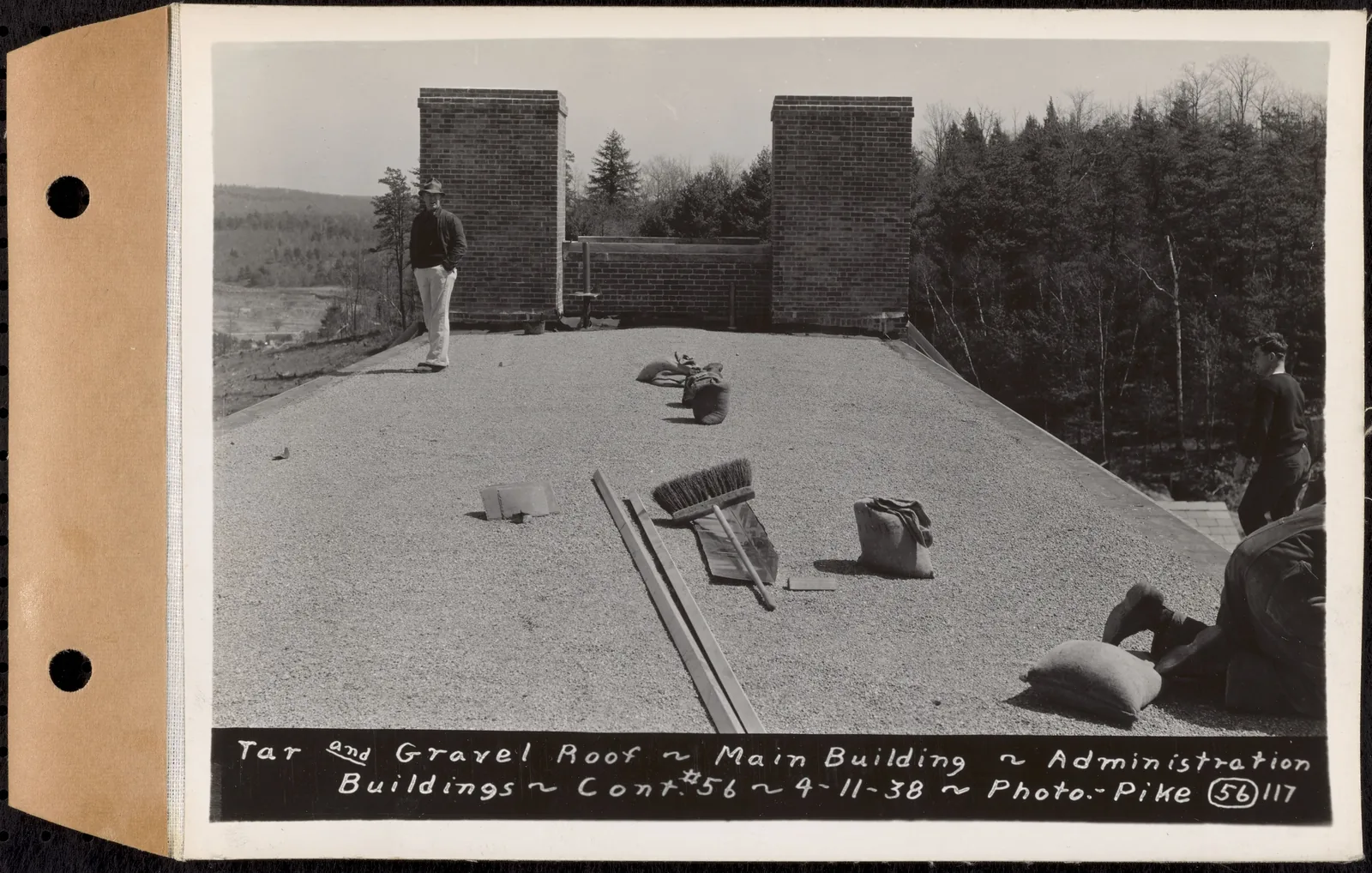
Built-up roofing — BUR — is a traditional low-slope system made of multiple plies of felt or fabric set in bitumen, often finished with a cap sheet or with gravel. You still find it on older commercial buildings and some additions along the Treasure Coast. Newer work may instead use modified bitumen or a single-ply such as TPO, but a BUR that is still in place has to be understood on its own terms.
For quotes, use our flat roofing matching pages and describe the existing system if you know it.
What BUR is, and how it differs from modified bitumen
A built-up roof is built in layers at the site. The number of plies, the type of bitumen, and the surfacing (smooth, coated, or gravel) define the assembly. Modified bitumen is a related asphalt family that uses factory-modified sheets; TPO is a different, thermoplastic single-ply. Repair methods that work on one do not automatically work on the others.
Gravel surfacing, where it exists, is part of the system’s UV protection and, in some older assemblies, of its fire or traffic performance. Do not rake it off casually. An inspection should say whether gravel is still even and whether the plies beneath are dry and attached.
Lifespan, drainage, and problems in Florida heat
Manufacturer “year” labels are warranty marketing, not a Florida performance guarantee. Heat, UV, salt air, installation quality, ventilation, and storms all matter. InterNACHI publishes a Florida-specific estimated life expectancy chart that is shorter than many national charts for several coverings; those figures are planning estimates, not warranties, and they can be shorter still after a major storm or a poor installation.
InterNACHI’s Florida chart lists built-up roofing at 5 to 15 years — a wide band that reflects how much condition, drainage, and surfacing matter. Heat, UV, and ponding age the bitumen. A well-maintained, well-drained BUR can be kept in service; a ponded, cracked, or wet BUR is often a replacement candidate.
Common problems: blisters, splits, failed flashings, clogged drains, bare spots where gravel or coating has worn away, and wet insulation hidden under a recover. Wind can scour gravel and start peel at edges if the perimeter was never adequately attached by today’s standards. A reroof may be a new BUR, a modified-bitumen recover or replacement, or a single-ply — each with a different approval and prep.
Pros and cons
Pros: multi-ply redundancy, a long history as a commercial system, and a repair vocabulary many low-slope crews still know. Cons: a modest InterNACHI Florida planning life, mess and odor during some applications, gravel maintenance where it is used, and the need to identify the existing assembly before anyone coats or recovers it.
Florida Building Code, wind, and product approval
The Florida Building Code, 8th Edition (2023), is the statewide code path here. The High-Velocity Hurricane Zone in that code is Miami-Dade and Broward Counties only. Port St. Lucie, the rest of St. Lucie County, Martin County, Indian River County, and Palm Beach County are outside the HVHZ, but they remain in a hurricane-prone region, and many addresses fall in the wind-borne debris region on the code’s maps (Figure 1609.3(1) for ordinary Risk Category II buildings, as published with the University of Florida GeoPlan Center map set).
A covering, underlayment, and fastener or clip system should be a Florida Product Approval assembly that matches the design pressures at the address, not a generic product name. The local building official decides what is acceptable on the permit. This educational page does not assign a wind speed to a lot; that comes from the code maps, a design professional, or the ASCE Wind Design Geodatabase.
For built-up roofing (bur), the tested assembly — not a marketing name — is what the official will look at.
Permits on the Treasure Coast
In the City of Port St. Lucie, a replacement typically needs a roof permit from the Building Department, which publishes a roof-replacement application, a re-roof checklist, and an e-permitting portal for registered licensed contractors. Unincorporated St. Lucie County, including River Park, uses the county’s Planning and Development Services office. Martin County publishes roof requirements and treats new roofs, roof repairs, and aluminum roofs as permitted work — confirm the current rule on the county’s official pages. Other cities and towns have their own officials. Roofing Port St. Lucie does not pull permits.
The contractor you hire should pull the permit for a built-up roofing (bur) project from the official who has the parcel.
Insurance, roof age, and wind mitigation
On homeowners’ policies issued or renewed on or after July 1, 2022, Fla. Stat. § 627.7011(5) limits refusals that are based solely on roof age (including a path for a homeowner-paid inspection showing at least five years of useful life on a roof 15 years or older). Insurers may still underwrite for condition and other lawful reasons. A wind-mitigation inspection can document covering type, roof shape, roof-to-wall connections, deck attachment, and secondary water resistance; only your insurer can say what that documentation is worth. This site does not complete those forms or give insurance advice.
The My Safe Florida Home program (Fla. Stat. § 215.5586) can include roof-related grant items such as stronger roof-to-wall connections, improved deck attachment, and secondary water resistance with a covering replacement, but only for applicants who meet the statutory and program rules then in force. Confirm current eligibility at mysafeflhome.com. An inspection is not a grant.
A built-up roofing (bur) roof can be described on a mitigation form only as it actually exists. This page is not a discount calculator.
Cost drivers, with national ranges
This site does not publish a Port St. Lucie average price. For national context only, Angi reported in its 2026 cost guide (updated October 22, 2026, based on 32,999 verified projects) a U.S. average roof replacement of $9,611, with most homeowners paying $5,903 to $13,380, and a typical range of about $4 to $11 per square foot of roof surface. Angi also published broad installed national ranges of about $5,800–$20,000 for asphalt shingles, $5,700–$25,000 for metal, and $8,500–$26,400 for tile, and permit fees often $100–$1,400 depending on the city. Those figures are nationwide survey results, not Treasure Coast bids.
For built-up roofing (bur), compare written local scopes that name the same products and details.
How to use this page
This page is educational. It is not a specification, a bid, or a claim that Roofing Port St. Lucie installs roofs. We are a free matching service. For quotes, use the matching service pages linked below and the form on this page.
Comparison
| Topic | Built-up (BUR) | Modified bitumen | TPO |
|---|---|---|---|
| How it is built | Multiple plies mopped or adhered on site | Factory-modified sheets, often multi-ply | Single-ply, usually heat-welded |
| InterNACHI Florida life estimate | 5–15 years | 10 years | 10–12 years |
| Typical Florida conversation today | Often an existing roof being evaluated | A common asphalt replacement or repair path | A common single-ply replacement path |
Matching service pages
This type page does not take the place of our service pages, which are where you request quotes:
Related roof types
Questions
01.Is a gravel roof a built-up roof?+–
Often, but not always. Gravel is a surfacing that appears on some BUR assemblies. An inspection or a core is how you know what is actually on the deck.
02.Can I put TPO over a BUR?+–
Sometimes a recover is allowed; sometimes wet materials or too many existing layers make a tear-off the cleaner path. That is a code, official, and condition question, not a default.
03.Where do I request quotes?+–
Use our flat roofing or commercial flat roofing matching pages and the form on this page.
Sources
- Florida Building Commission, Florida Building Code, 8th Edition (2023)
- University of Florida GeoPlan Center, Florida Building Code 8th Edition (2023) wind-speed maps, including Figure 1609.3(1) for Risk Category II buildings
- Florida Building Commission, Product Approval search
- City of Port St. Lucie Building Department, Building Permits: Applications, Fees and Checklists
- St. Lucie County Planning and Development Services, Permit Applications
- Martin County, Apply for a Building Permit
- Martin County, Roof Requirements
- Fla. Stat. § 627.7011 (2025), Homeowners’ policies; offer of replacement cost coverage and law and ordinance coverage
- Fla. Stat. § 215.5586, My Safe Florida Home Program
- My Safe Florida Home program, Florida Department of Financial Services
- Angi, “How Much Does Roof Replacement Cost? [2026 Data],” updated Oct. 22, 2026 (national averages from 32,999 verified projects)
- InterNACHI, Estimated Life Expectancy Chart for Florida Homes (roofing table)
- Insurance Institute for Business & Home Safety, Hurricane Harvey Wind Damage Investigation (2018)
- FEMA P-2181, Hurricane and Flood Mitigation Handbook for Public Facilities, Fact Sheet 3.3.1: Roof Systems—Sloped Roofs
- U.S. Department of Energy, Building America Solution Center, “Hip Roof vs Gable Roof,” citing wind-tunnel studies including Meecham (1992) and Shao et al. (2018)
- Florida Department of Business and Professional Regulation, license search
Photo credits
- Photo: Contract No. 56, Administration Buildings, Main Dam, Belchertown, tar and gravel roof, main building, Belchertown, Mass., Apr. 11, 1938, Massachusetts Metropolitan District Water Supply Commission, public domain, via Wikimedia Commons / DPLA. Wikimedia Commons · Public domain
Back to the roof types hub.